
Coffee and Cardiovascular Disease: Reviewing New AHA Guidance
There are some respectable RCTs referenced by the AHA. The most definitive is regarding caffeine intake and recurrence of atrial fibrillation or flutter. This was a prospective, open-label, randomized clinical trial called DECAF.


On July 20th, 2026, the American Heart Association (AHA) released new guidance regarding the effects of caffeine intake, most notably from coffee, on the risk of cardiovascular disease. You can find the new guidance document here.
The major headline you'll see across news organizations will look something like this: Up to 5 coffees a day safe for heart health, says AHA: What coffee type is best?
Let's take a deeper look at the evidence explored throughout the article and see what we can conclude!
The overall clinical conclusion of the authors was as follows:
"The convergence of evidence from large cohort studies and small randomized controlled trials supports the conclusion that moderate caffeine or coffee consumption (up to 400 mg/d caffeine or ≈3–5 cups of coffee at 8 oz per cup) is safe for most adults and is associated with lower risk of cardiovascular disease, including coronary heart disease, stroke, heart failure, and artrial fibrialation, as well as hypertension and type 2 diabetes. Indeed, large prospective cohort studies with long-term follow-up consistently demonstrate modest inverse associations between habitual coffee consumption and all-cause mortality across diverse populations. These associations are typically nonlinear, with the lowest mortality risk observed at moderate levels of intake (2–4 cups/d), and are generally robust after adjustment for smoking and other lifestyle factors. Similar inverse associations have been reported for both caffeinated and decaffeinated coffee, supporting the contribution of noncaffeine bioactive components."
However, the definitiveness of this statement has raised some eyebrows, particularly regarding the specific recommendation for up to 400mg per day of caffeine. How do we know that 200mg or 600mg isn't best? How strong are the associations between coffee and decreased risk of heart failure, atrial fibrillation (AF), and hypertension? How strong is the implied association between higher caffeine intake and negative health outcomes?
The vast majority of data on the topic comes from retrospective observational studies, which can range from occasionally useful to completely useless. We've discussed this on RxTeach many times, but there is good reason why randomized controlled studies (RCTs) are considered the gold standard.
Think about the differences that might exist between coffee drinkers and non-coffee drinkers. For instance, we know that people who make more money generally have better health outcomes due to enhanced access to care, ability to pay, lower stress, etc. If there are significant economic differences between coffee drinkers and non-coffee drinkers, the data would be biased. Here's what ChatGPT has to say:
The highest coffee consumers tend to include:
- Physicians
- Nurses
- Scientists
- Engineers
- Software developers
- Finance professionals
- Attorneys
- Journalists
- Executives
The lowest coffee consumption tends to occur among:
- Children and adolescents
- Some retirees
- Members of religions discouraging caffeine (e.g., many practicing members of The Church of Jesus Christ of Latter-day Saints)
- Individuals with anxiety disorders or cardiac arrhythmias who avoid caffeine
What about lifestyle and other socioeconomic indicators like education?
Coffee drinkers are:
- More likely to have a college degree
- More likely to have a higher income
- More likely to work full time in professional occupations
- More likely to exercise
- Slightly leaner
Weighing each of these variables accurately and ensuring balance between comparator groups is nearly impossible.
How about general wellbeing? If you wake up feeling chronically ill and nauseous, are you more or less likely to consume coffee? If you're preparing to go on a run or hit a serious workout, are you more or less likely to consume caffeine? What does that mean for your mortality risk? The confounders go on and on, hence the issue with retrospective epidemiologic studies like the UK Biobank paper referenced in the review article. The data can still be useful, but we must interpret cautiously.
Similar issues exist when distinguishing between different sources of caffeine (Redbull vs coffee vs tea) or between people who drink 2 cups vs 8 cups of coffee per day. It might be easy to claim that energy drinks or high caffeine consumption leads to worse outcomes, but you would again expect major differences between those groups. The average amount of caffeine consumed per day, age, income, fitness, risk-taking tendencies, education, and general health awareness will likely differ significantly between those groups. This is why randomization and careful analysis of baseline characteristics are so important when analyzing data.

There are some respectable RCTs referenced in the article as well. The most definitive is regarding caffeine intake and recurrence of AF or flutter. This was a prospective, open-label, randomized clinical trial from November, 2025 called DECAF.
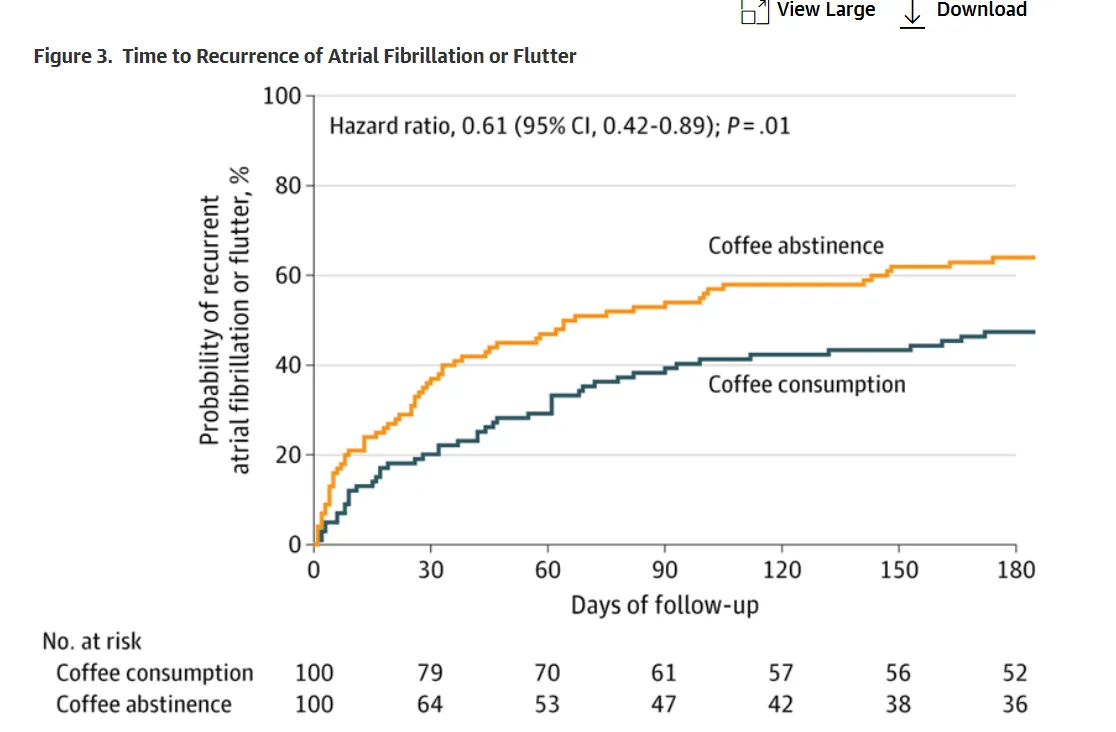
As you can see, coffee consumption led to a lower probability of AF recurrence compared to coffee abstinence. This is a particularly interesting finding because many patients choose to completely avoid caffeine after an atrial fibrillation diagnosis. This study lacks many of the deficiencies discussed above because the 2 groups had similar baseline coffee intake and the patients were randomized upon cardioversion, limiting potential bias between groups.
This RCT still leaves some questions unanswered. What are the long-term outcomes beyond 180 days? How does the risk of stroke change? What if having more AF leads to more DOAC and therefore less stroke? Obviously we can't possibly know the answer from this RCT alone because there were no strokes or deaths in either group due to the short follow-up time, and the trial wasn't designed to answer these questions anyway. Regardless, I commend the DECAF authors for clearly articulating the outcomes, strengths, and limitations of their data.

The general conclusion of the AHA is one I agree with:
"According to this evidence, habitual moderate coffee consumption can be part of a healthy lifestyle. Although coffee is the main source of caffeine for most adults, tea, coffee, chocolate, and energy drinks also contribute to overall caffeine intake. Acute effects of caffeine can include transient increases in blood pressure, blood sugar, and alertness, as well as palpitations or sleep disruption in some individuals. Individual differences in genetic variation in caffeine metabolism partially explain the variability in caffeine tolerance and clinical response, although there is insufficient evidence to demonstrate that they modify the effects of habitual coffee consumption on chronic diseases or mortality. Large amounts of added sugar, flavored syrups, and dairy products can substantially increase caloric intake and counteract potential health benefits associated with coffee itself. Last, as alluded to throughout this scientific statement, limitations of various study designs used should be considered in the interpretation of these results. For example, “healthy user bias” may be especially operative among research participants who consume substances such as caffeinated coffee in moderation."
Here, the authors are much less definitive, point out potential bias, and don't recommend a specific amount of caffeine consumption. The truth is, the data in this area are so poor that we really can't tell patients whether 0, 1-3, 4-6, or 7-10 cups of coffee is best for their overall health. There are simply too many confounders to contend with in the epidemiologic data, and a near-complete lack of useful, long-term RCTs to reference. Perhaps the scientific community will accumulate such evidence in the future, at which point you'll likely be hearing my opinion again! (Strong emphasis on opinion) Given the current state of evidence, I'll continue having whatever amount of coffee I happen to want on any given day.
*Information presented on RxTeach does not represent the opinion of any specific company, organization, or team other than the authors themselves. No patient-provider relationship is created.